Flake Drying Systems and Flake Dryer Cooler - Atlas Yem
Flake Drying Systems
Atlas Yem | Feed Milling, Flaking & Recycling Technology
Flake Drying Systems All Products
Flake Drying Systems and Flake Cooler
What is a flake drying system?
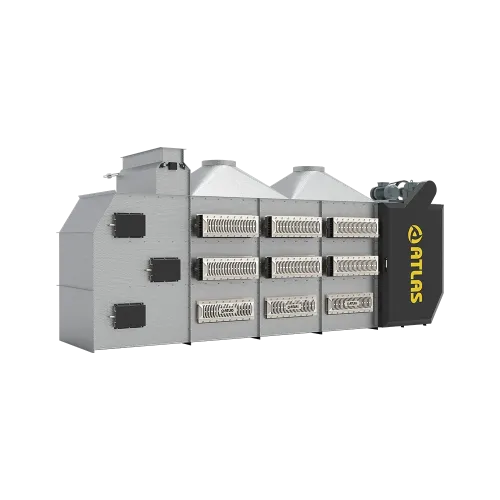
A flake drying system is the unit that reduces the moisture and temperature of grain that has been steam-cooked and flattened between rollers. In a flake plant, the product leaves the cooking and flaking stages hot and moist. The drying system first cools the product with a controlled air flow, then dries it, making it ready for storage and packaging.
Atlas Yem flake drying systems are designed to work in harmony with the flake steam cooking tower and flaking mills. This preserves product quality at the final stage of the production line.
At which stage is a flake drying system used?
- The grain is cleaned and fed into the production line.
- It is conditioned and cooked in the steam tower.
- It is flattened to the desired thickness in the flaking mills.
- It is cooled and dried in the flake dryer cooler unit.
- It is transferred to storage or packaging.
Why are flakes dried?
Flaked feed coming out of the flaking process cannot be kept in this state for long because of its high moisture and temperature. Product left uncontrolled can heat up, grow mould and lose its quality. Drying hardens the flakes and prevents the product from breaking apart during transport and storage.
The most important point at this stage is not to damage the grain starch. The starch gelatinisation achieved during cooking is preserved through correct drying. This directly affects the digestibility and nutritional value of flaked feed.
What problems occur in flakes that are not dried?
- Risk of mould and heating due to high moisture
- Caking during storage
- Broken flakes and a higher dust ratio
- Shorter shelf life
- Loss of quality in the starch structure
How does a flake dryer cooler work?
A flake dryer cooler passes the product coming from the rollers through a defined air flow. The air penetrates every flake evenly, first lowering the temperature and then removing excess moisture. Since resting the product after flaking is essential, drying is carried out in a controlled manner and for a sufficient period of time.
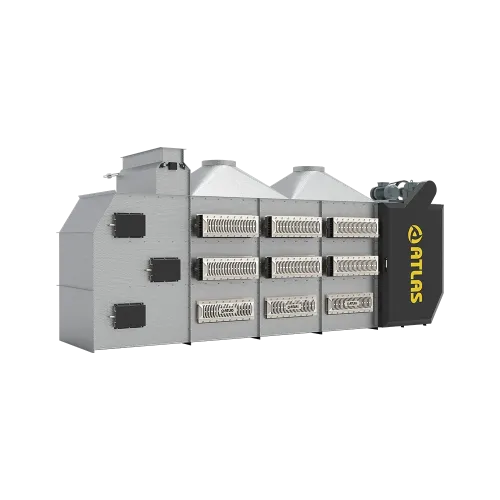
Atlas Yem AFHD03 and AFHD04 flake dryer models operate with 5.5 kW motor power and a capacity of 4-7 tons per hour. Thanks to homogeneous air distribution, the product dries evenly and dust losses are kept to a minimum.
What should be considered in the flake drying process?
- Homogeneous distribution of air flow across the product layer
- Sufficient retention time of the product in the dryer
- Regular monitoring of outlet moisture and temperature values
- Avoiding excessive temperatures that could damage the starch
- Matching dryer capacity with flaking mill capacity
Why is drying important after the barley flake machine and corn flake machine?
The barley flake machine and the corn flake machine turn steam-conditioned grain into thin flakes. When these flakes leave the rollers, they are both soft and moist. Without drying, the shape and quality achieved during flaking cannot be preserved.
Barley and corn differ from each other in kernel structure and moisture retention. For this reason, drying time and air settings should be determined according to the grain being processed. A correctly adjusted drying system delivers uniform quality for both products.
What is checked when drying barley and corn flakes?
- Flake thickness
- Moisture content of the product after cooking
- Target outlet moisture and storage conditions
- Hourly capacity of the barley flake machine or corn flake machine
- Retention time of the product in the dryer
What capacity of drying system should be chosen for a flake plant?
The drying system should be selected according to the hourly production capacity of the flake plant. If dryer capacity falls below the capacity of the cooking tower and flaking mill, the line becomes a bottleneck. An oversized dryer, on the other hand, creates unnecessary investment and energy costs.
In corn flake line and barley flake line projects, Atlas Yem plans cooking, flaking and drying equipment with matching capacities.
Which criteria are important when choosing a drying system?
- Hourly production capacity (tons/hour)
- Type of grain to be processed: barley, corn or wheat
- Compatibility with cooking tower and flaking mill capacity
- Energy consumption and motor power
- Available floor space and ease of maintenance
What determines the installation cost of a flake plant?
The installation cost of a flake plant varies according to plant capacity, the type of grain to be processed and the equipment used. A flake line does not consist only of a barley flake machine or corn flake machine. The steam boiler, cooking tower, flake drying system, conveying equipment and automation also make up a significant part of the total investment.
Atlas Yem offers solutions sized to your needs in turnkey flake plant projects. This balances the investment cost with long-term operating expenses.
What are the main items affecting flake plant cost?
- Target production capacity
- Steam boiler and steam line infrastructure
- Selection of cooking tower, flaking mill and dryer
- Automation and control systems
- Building, steel construction and installation costs
2 from the product 1–2 Showing between