What Is a Vibrating Screen and What Is It Used For? - Atlasyem
News
What Is a Vibrating Screen and What Is It Used For?
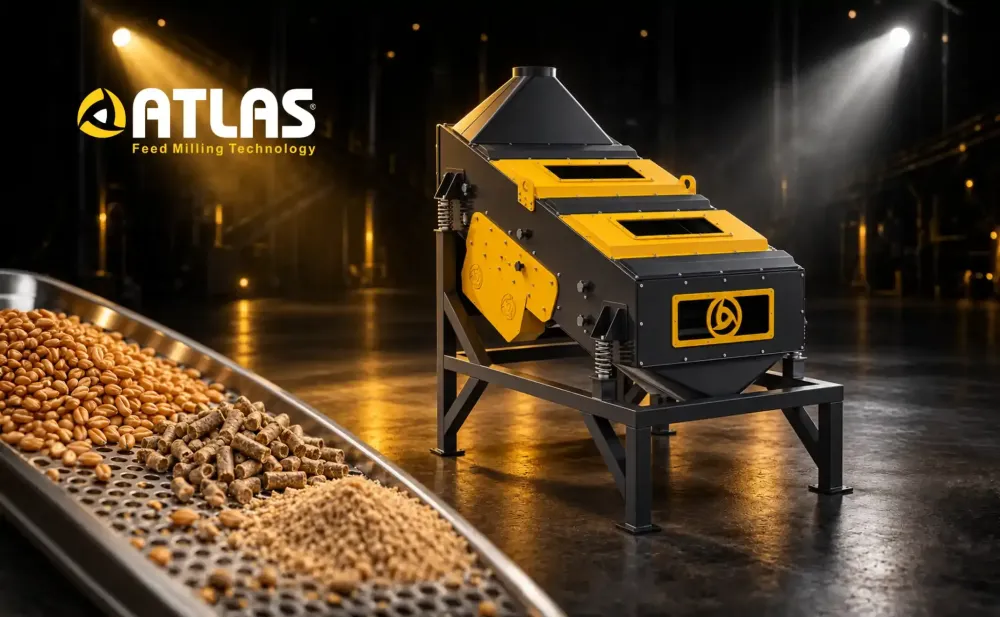
A vibrating screen is screening equipment used to separate materials of different sizes through vibrating motion. It is particularly used in feed production plants to help separate raw materials and processed products according to the required particle sizes. A vibrating screen helps make the screening process in the production line more organized and can also be used in different designs known as vibrating screening machines.
What Is a Vibrating Screen?
A vibrating screen is a system that moves material across a screen surface through vibration and classifies it according to particle size. Controlled vibration on the screen surface allows particles of the appropriate size to pass through while helping separate larger particles.
How Does a Vibrating Screen Work?
The operating principle is based on the vibrating motion applied to the screen surface. As the material moves across the screen, it is separated into different groups according to its size.
-
Vibrating motion is generated.
-
Raw material or product is transferred onto the screen surface.
-
Small particles pass through the screen openings.
-
Larger particles continue moving across the screen.
-
Separated materials are discharged through different outlets.
What Is a Vibrating Screen Used For?
A vibrating screen is used to separate materials according to their size and remove unwanted particles during production. In feed mills, it can be used particularly for product control after grinding and pelleting processes.
In Which Processes Is a Vibrating Screen Used?
It can be used at different production stages where screening is required. Its purpose may vary depending on the production capacity of the plant and the type of product being processed.
-
Raw material classification
-
Screening of ground products
-
Product control after pelleting
-
Separation of dust and fine particles
-
Classification of products of different sizes
What Are the Types of Vibrating Screens?
Vibrating screen types vary according to the number of screen decks, capacity, screen opening size, and area of application. When selecting a system for a production line, the characteristics of the material to be processed and the capacity of the plant should be considered.
What Should Be Considered When Choosing a Vibrating Screen?
When choosing among different types of vibrating screens, considering only the machine's capacity is not sufficient. The particle characteristics of the product and the required screening accuracy should also be evaluated.
-
Production capacity
-
Screen surface dimensions
-
Screen opening size
-
Material density
-
Screening accuracy
-
Existing equipment in the plant
How Is Screening Performed with a Vibrating Screening Machine?
A vibrating screening machine generates vibrating motion that allows material to move across the screen surface in a controlled manner. This movement helps distribute the product more evenly across the screen and enables separation according to particle size.
In Which Plants Are Vibrating Screening Machines Used?
Vibrating screening machines can be used in various industrial production lines. In feed production, they can be integrated into grinding, screening, and product control stages depending on process requirements.
-
Feed production plants
-
Grain processing plants
-
Agricultural product processing lines
-
Raw material classification systems
-
Pellet production lines
Why Is a Vibrating Screen Used in a Feed Mill?
During feed mill installation, the screening system is planned according to the overall operating structure of the production line. A vibrating screen helps separate raw materials and finished products into appropriate particle sizes, supporting process control throughout production.
How Is the Screening System Planned During Feed Mill Installation?
In a feed mill installation project, screen selection should not be made independently of other machinery. A compatible process should be created with grinding, conveying, dosing, and pelleting systems.
-
Production capacity is determined.
-
Raw materials to be processed are evaluated.
-
Screening points are identified.
-
Suitable screen opening sizes are selected.
-
Connections with conveying systems are planned.
-
Integration with the automation system is provided.
How Is a Vibrating Screen Positioned in a Turnkey Feed Mill Project?
In turnkey feed mill projects, the screening system is positioned according to the overall process flow of the plant. This allows the vibrating screen to operate together with equipment of the appropriate capacity at the required stage of production.
What Systems Are Included in a Turnkey Feed Mill?
A turnkey feed mill project involves more than the installation of a single machine. It is important to design the production line as an integrated system. The screening system is one of the components of this overall structure.
-
Raw material intake systems
-
Crushing and grinding systems
-
Dosing units
-
Mixing systems
-
Pelleting systems
-
Cooling and screening systems
-
Packaging and storage units
How Does Vibrating Screen Selection Affect Production?
A suitable vibrating screen contributes to regulating material flow within the production line and achieving the required particle sizes. Selecting an unsuitable capacity or screen opening size may reduce screening efficiency.
Why Is Capacity Important When Choosing a Vibrating Screen?
The capacity of the screen should be compatible with the production line. Particularly in high-capacity plants, ensuring that the screening system operates at a rate compatible with other equipment is important for production continuity.
-
Hourly production volume
-
Product type
-
Particle size
-
Position of the screening stage
-
Capacity compatibility between equipment
What Materials Can Be Screened with a Vibrating Screen?
A vibrating screen can be used to classify grains and feed raw materials with different characteristics. The result of the screening process depends on the properties of the screen surface and the characteristics of the material being processed.
Which Products Are Screened in Feed Production?
A vibrating screening machine used in feed plants can separate different materials depending on the production process.
-
Corn
-
Wheat
-
Barley
-
Feed raw materials
-
Ground grains
-
Pellet products
-
Dust and fine particles
Frequently Asked Questions
Are a Vibrating Screen and a Vibro Screen the Same?
Their general operating principles are similar. Both systems use vibrating motion to classify materials on a screen surface. However, machine design and intended use may vary depending on the model.
How Is Vibrating Screen Capacity Determined?
Capacity is determined according to criteria such as the type of product being processed, material density, particle size, screen area, and the total capacity of the production line.
Are Vibrating Screens Used in Feed Mills?
Yes. Vibrating screens can be used in feed production plants to separate raw materials or processed products according to particle size. They can be integrated into the production line, particularly during screening and product control stages.
Is Screen Selection Important When Installing a Turnkey Feed Mill?
Yes. When installing a turnkey feed mill, all equipment should be compatible in terms of capacity and process requirements. The screening system should also be planned according to the overall production flow of the plant.
How Is a Vibrating Screening Machine Maintained?
As part of regular maintenance, the screen surface, connection points, vibration mechanism, and motor system should be inspected. Worn or damaged parts should be replaced when necessary to support efficient operation.