How Is Animal Feed Produced? Process & Stages | Atlas Yem
News
How Is Animal Feed Produced?
Feed production is carried out by preparing raw materials suited to the nutritional needs of animals in specific proportions, then processing, mixing and shaping them into the desired form. Depending on the type of feed, grains, protein sources, vitamins, minerals and various additives may be used. In modern feed mills, this process consists of stages such as raw material intake, grinding, dosing, mixing, pelleting, cooling and packaging. With its expertise in feed mill installation and feed technologies, Atlas Yem develops production lines suited to different capacities.
How Does Feed Production Begin?
The first stage of feed production is determining the raw materials to be used and receiving them at the plant. The type of raw material depends on the composition of the feed and the nutritional needs of the animal group. Grains, oilseeds, protein sources, and mineral and vitamin additives can be among the basic components used in production.
Which Raw Materials Are Used in Feed Production?
The raw materials used in feed production vary according to the characteristics of the product. It is important that raw materials are stored under suitable conditions and pass the necessary checks before production.
- Corn
- Barley
- Wheat
- Soybean and protein sources
- Bran
- Mineral sources
- Vitamins and additives
- Other feed raw materials
How Are Raw Materials Processed in Feed Mills?
In feed mills, raw materials are processed in accordance with the production recipe. Coarse raw materials can be ground to the desired particle size. The raw materials are then transferred to the production line in defined proportions by dosing systems. The feed machinery and production systems developed by Atlas Yem help these stages run in an orderly way.
Why Is Grinding Done?
Grinding is applied mainly to bring grains to a more suitable particle size. Ground raw materials can be mixed and processed more easily in the subsequent production stages.
The characteristics of the grinding process may vary depending on the type of feed and the raw materials used. For this reason, the grinding equipment in a feed mill must be selected in line with its capacity.
How Is Dosing Done in Feed Production?
Dosing ensures that different raw materials are taken into the system in quantities that match the prepared feed recipe. Since the amount of each raw material used in production may differ, precise dosing is one of the key stages of the feed production process.
Why Is Dosing Important?
A properly working dosing system helps ensure that the feed is prepared according to the recipe. The dosing systems used within Atlas Yem's feed technologies can be engineered to transfer different raw materials to the production line in a controlled manner.
- The quantity of raw material is controlled.
- Recipe ratios are applied.
- Different raw materials are transferred into the system.
- The production process becomes more controlled.
How Is Mixing Done in Feed Production?
The dosed raw materials are transferred to the mixing unit with the aim of obtaining a homogeneous mixture. During mixing, the different raw materials are distributed evenly in accordance with the production recipe.
In feed mill projects, Atlas Yem plans mixing units according to production capacity and the overall structure of the plant. This allows raw materials to be processed on the production line in a controlled way after dosing.
What Should Be Considered When Mixing Feed?
Mixing time, the raw materials used and the capacity of the mixer can affect the production process. To achieve a homogeneous mixture, it is important to choose equipment suited to the production capacity.
- Mixing time
- Mixer capacity
- Raw material quantity
- Product characteristics
- Recipe structure
- Production capacity
How Is Flaked Feed Produced?
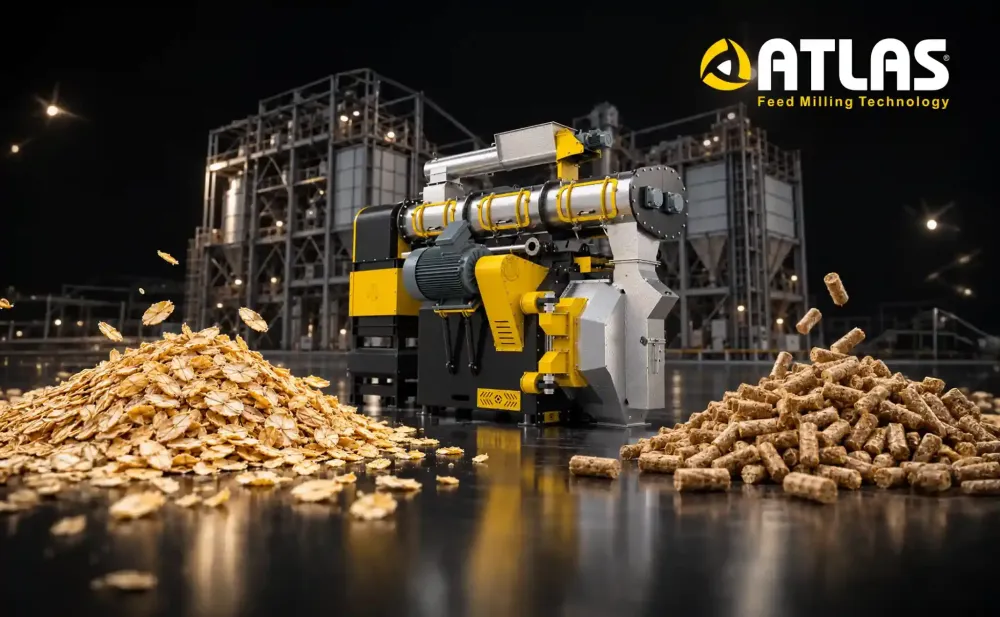
In flaked feed production, grains such as corn and barley are conditioned with steam and heat and then crushed between rollers into flakes. The resulting product is used as flaked feed in feed production.
With its expertise in flaking technologies, Atlas Yem develops flake production systems that can be integrated into feed mills. Especially in plants that want to process grains in flake form, it is important to plan the flake line according to production capacity.
Which Grains Are Used in Flake Production?
Flake production can use various suitable grains, primarily corn and barley. The raw materials and production conditions are determined according to the characteristics of the flaked product.
- Corn
- Barley
- Other grains with suitable properties
How Does a Flake Plant Work?
A flake plant is the combination of systems used to prepare grains, condition them with steam and heat, crush them in rollers and transfer the product to the production line. A flake plant does not consist of a flaking machine alone; equipment for raw material preparation, steaming, conveying, cooling and storage can also be part of the system.
What Equipment Is Found in a Flake Plant?
The equipment of a flake plant is determined by the production capacity and the product to be processed. Atlas Yem can plan the equipment for flake production lines in line with the plant's overall production structure.
- Raw material preparation systems
- Steaming and conditioning equipment
- Flaking machine
- Conveying systems
- Cooling equipment
- Storage systems
- Automation system
How Is Pellet Feed Produced?
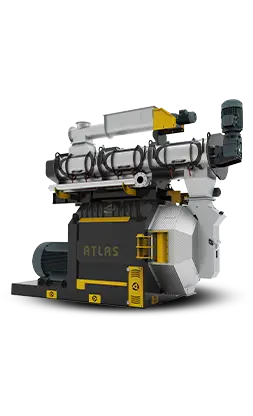
In pellet feed production, the prepared and homogeneously mixed feed raw materials are transferred to the pelleting system. Here the product is compressed under suitable conditions into pellets of a specific diameter and length. It then passes through cooling to lower its temperature and, if necessary, is screened before moving on to packaging.
How Does a Pelleting System Work?
A pelleting system turns feed raw materials into pellets of a specific form and density. Proper preparation and conditioning of the product before pelleting is important.
In feed mill projects, Atlas Yem develops pelleting system solutions suited to production capacity, ensuring the pellet feed line works in harmony with the other equipment.
Why Is Cooling Necessary in Feed Production?
After pelleting, the temperature of the product rises. Cooling is therefore applied to bring the pellets to suitable conditions. Cooling is important so that the pellets can move on to the next stages of the production line.
What Happens in the Cooling Unit?
In the cooling unit, the temperature of the pellets is lowered in a controlled manner. A system designed for the production capacity helps the pellets move on to the following stages.
- Pellet temperature is reduced.
- The product is cooled in a controlled manner.
- The product is prepared for storage.
- Continuity of the production line is supported.
Why Is Screening Done in Feed Production?
After pelleting and cooling, the product can be transferred to the screening unit. Screening is carried out to separate unwanted particles from the product and send pellets of the right size on through the production line.
The screening systems used within Atlas Yem's feed technologies can be planned according to production capacity and product structure.
What Is Checked During Screening?
During screening, the particle or pellet size of the product is checked. Unsuitable particles are separated from the system, while products with the desired properties can be sent to packaging or storage.
How Is Packaging Done in Feed Production?
At the end of the production process, the finished feed can be packed into bags or other packaging, depending on the plant's system. In the packaging unit, the product is packed in defined quantities and prepared for shipment.
What Happens in the Packaging Unit?
The capacity of the packaging system should match the production capacity of the feed mill. In feed mill projects, Atlas Yem also helps plan packaging solutions suited to the needs of the production line.
- The product is weighed.
- It is filled into packaging in the defined quantity.
- The package is sealed.
- The product is prepared for shipment.
How Is a Feed Mill Installed?
Feed mill installation is a comprehensive process that begins with determining all the equipment on the production line and positioning it correctly within the plant. With its engineering experience in feed mill installation, Atlas Yem plans every production stage as a whole, from raw material intake to finished product storage.
Which Systems Are Used in Feed Mill Installation?
Different machines may be used depending on the capacity of the plant and the type of feed to be produced. Production lines designed by Atlas Yem may include the following systems as required:
- Raw material intake systems
- Storage equipment
- Grinding systems
- Dosing units
- Mixing systems
- Flake plant
- Pelleting system
- Cooling and screening units
- Packaging systems
- Automation and control systems
How Is a Turnkey Feed Mill Built?
In turnkey feed mill projects, the engineering, equipment, assembly, automation and commissioning processes of the plant are planned as a whole. Atlas Yem evaluates production capacity and product requirements to develop solutions for the entire plant.
What Is Planned in a Turnkey Feed Mill?
When building a turnkey feed mill, selecting the machines alone is not enough. All stages of the production line must work in harmony with one another.
- Plant capacity is determined.
- The production flow is designed.
- Feed machinery is selected.
- Raw material and finished product storage areas are planned.
- Conveying systems are determined.
- The automation system is set up.
- The production line is installed.
- Testing and commissioning are carried out.
How Is Quality Ensured in Feed Production?
Quality in feed production depends on many factors, from the raw materials and production recipe to machine settings and the mixing and pelleting processes. Correct selection and regular operation of the equipment on the production line are also important.
With its engineering approach to feed technologies, Atlas Yem plans the systems used at different stages of the production line to work in harmony. This approach helps establish a controlled and orderly production process in feed plants.
What Should Be Considered in Feed Production?
For the feed production process to run efficiently, many factors, from raw material quality to machine capacity, should be evaluated together.
- Raw material quality should be checked.
- Recipes should be applied correctly.
- The dosing system should work properly.
- Mixing should be carried out in a controlled manner.
- The pelleting system should be selected according to capacity.
- If there is flake production, the flake line should be planned correctly.
- The product should be cooled under suitable conditions.
- Storage and packaging processes should be managed correctly.
Why Does Atlas Yem Stand Out in Feed Production?
With its engineering experience in feed mill installation, feed machinery and feed technologies, Atlas Yem offers comprehensive plant solutions to feed producers. It handles every production stage as a whole, from raw material intake to grinding, from dosing to mixing, and from flake production to pelleting.
Developing systems tailored to plant capacity and production targets in turnkey feed mill projects, Atlas Yem also offers specialized solutions in flaking technologies. Focused on ensuring that the machinery and equipment modern feed plants need work in harmony, Atlas Yem brings engineering and technological strength together in feed mill investments.