What Is Particle Size Reduction? - Atlas Yem
News
What Is Particle Size Reduction?
Particle size reduction is the process of breaking raw materials such as corn, barley, wheat and soybean meal into smaller, more uniform particles. In a feed mill, it is usually the first processing step after raw material intake and cleaning. The way grains are ground affects mixing quality, pellet durability, energy use and, ultimately, animal performance. For this reason, particle size reduction in feed production is treated as a key quality step rather than a simple crushing job.
Why Is Particle Size Reduction Important in Feed Production?
Smaller particles offer a larger surface area to digestive enzymes, which helps animals make better use of the nutrients in the ration. A consistent particle size also allows micro ingredients, vitamins and minerals to be distributed evenly in the mixer. When particle size reduction is done correctly, the feed mill produces a homogeneous mash that is easier to condition and pellet.
What are the main benefits of correct grinding?
A well-managed grinding step brings advantages across the whole production line:
- Better nutrient digestibility
- More uniform mixing of ingredients
- Higher pellet quality and durability
- Less segregation during transport
- Lower energy consumption in later process steps
How Does Particle Size Reduction Work in a Feed Mill?
Raw materials are first cleaned to remove stones, metal parts and foreign matter. They are then fed into a mill, where mechanical force breaks the grains into smaller pieces. The ground material passes through a screen or between rollers that control the final size, and it is then conveyed to the batching and mixing section.
Which steps are involved in the grinding process?
In most feed mills, the grinding process in feed production follows this order:
- Raw material intake and pre-cleaning
- Magnetic separation of metal particles
- Grinding in a hammer mill or roller mill
- Screening and particle size control
- Transfer to bins for dosing and mixing
What Equipment Is Used for Particle Size Reduction?
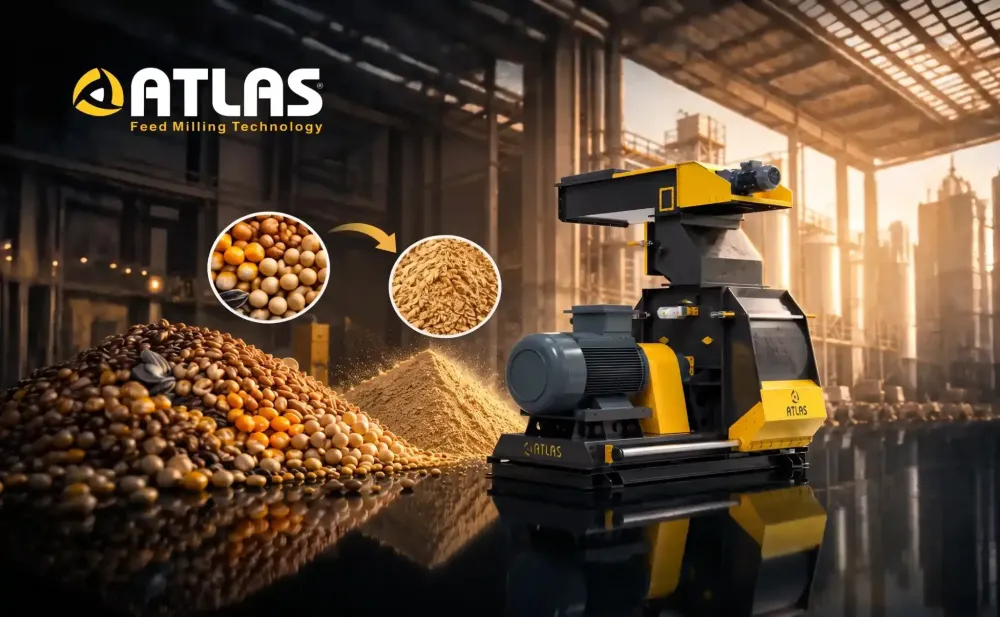
The two most common machines are hammer mills and roller mills. A hammer mill uses rotating hammers that strike the material until it is small enough to pass through a perforated screen. A roller mill crushes the grains between pairs of rotating rolls, which produces a more uniform particle with fewer fines. Atlas Yem offers both solutions in its crushing systems range, so the mill can be selected according to the raw material and the target product.
How do hammer mills and roller mills differ?
Each machine has its own strengths:
- Hammer mills are flexible and handle many raw materials
- Roller mills produce a narrower particle size distribution
- Roller mills generally create less dust and fewer fines
- Hammer mills are often preferred for fine grinding
- The choice depends on the species being fed and the feed form
What Is the Ideal Particle Size for Animal Feed?
There is no single ideal size for every ration. Poultry, swine, ruminant and aquafeed formulations all have different requirements, and the feed form also matters. Pelleted feeds usually benefit from finer grinding, while mash feeds for some species may need a coarser structure. You can read more about target values in our guide to the ideal particle size in feed grinding.
What factors determine the target particle size?
Nutritionists and mill managers usually consider:
- Animal species and age
- Feed form: mash, pellet or crumble
- Type and hardness of the raw material
- Conditioning and pelleting conditions
- Energy cost per ton of feed
How Can Feed Mills Improve Particle Size Consistency?
Particle size consistency in feed depends on stable operating conditions. Worn hammers, damaged screens and uneven roll gaps cause variation from batch to batch. Regular sampling and sieve analysis help the team detect these problems early and keep the ground product within specification.
What helps keep particle size under control?
The following practices support consistent results:
- Regular inspection of hammers, screens and rolls
- Steady and controlled feeding of the mill
- Routine sieve analysis of ground samples
- Correct screen size for each raw material
- Automation that adjusts feed rate to motor load
How Can Feed Mills Reduce Energy Consumption in Grinding?
Grinding is one of the most energy-intensive steps in a feed mill. Grinding finer than the ration actually needs increases power use without improving feed value. To reduce energy consumption in grinding, the mill should be sized correctly, maintained regularly and operated at a stable load.
Which measures lower grinding energy costs?
Some practical measures include:
- Avoiding unnecessary over-grinding
- Choosing the right mill type for each material
- Keeping wear parts in good condition
- Using pre-screening to bypass already fine material
- Matching mill capacity with the rest of the line
Why Is Particle Size Reduction Part of Feed Mill Efficiency?
Particle size reduction affects almost every process that follows it. A well-ground mash mixes faster, conditions more evenly and passes through the pellet die with less resistance. As a result, correct grinding supports higher throughput, lower downtime and better final product quality. Atlas Yem designs the grinding section together with the dosing, mixing and pelleting stages so that the whole feed mill works as one efficient system.
Which parts of the line are affected by grinding quality?
Grinding quality has a direct impact on:
- Mixing time and mixing homogeneity
- Steam absorption in the conditioner
- Pellet die wear and pellet durability
- Dust levels and material losses
- Overall feed mill throughput