Is There Government Support for Setting Up a Feed Mill? - Atlas Yem
News
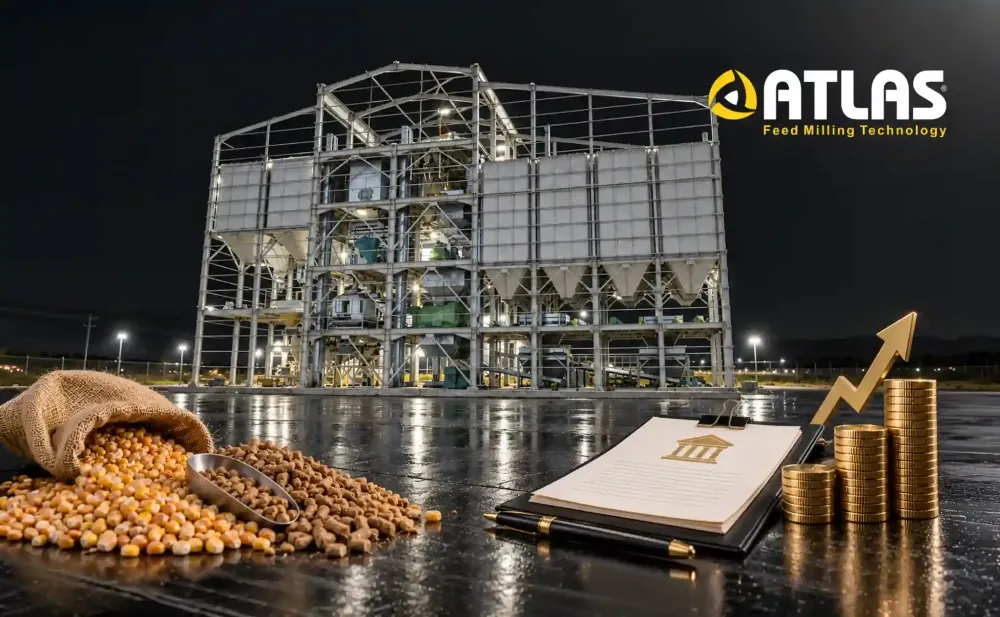
Is There Government Support for Setting Up a Feed Mill?
One of the most common questions investors ask before setting up a feed mill is whether government support is available. The short answer is yes, but not every investment qualifies for every program. The support available for feed mill installation depends on the type of investment, the region where it will be built and the program conditions in effect during the application period. In this article, we summarize the main support programs and the key points to consider before applying.
What government support is available for feed mill installation?
In Türkiye, support for feed production facility investments comes mainly from three sources: the Rural Development Investment Support Program (KKYDP) of the Ministry of Agriculture and Forestry, the EU-funded IPARD III program, and the investment incentive system of the Ministry of Industry and Technology. Each program differs in scope, grant rate and application requirements.
Which programs can feed mill investors consider?
The following programs can be reviewed when planning the investment:
- Rural Development Investment Support Program (KKYDP)
- TKDK grant calls under IPARD III
- Tax and customs advantages under an investment incentive certificate
- Favorable credit options for agricultural investments
Does rural development support cover feed mill installation?
According to the communiqué published in the Official Gazette on 3 April 2026, KKYDP grants can cover between 50% and 70% of the project amount. The upper limit of the eligible project amount is TRY 30 million, and TRY 8 million for family businesses. However, for feed projects, only capacity expansion and modernization of existing facilities are supported, not the construction of new facilities from scratch. In provinces affected by the 6 February 2023 earthquakes and declared disaster areas, all feed projects are eligible for support.
Which KKYDP conditions stand out for feed investments?
Key points to note under the 2026 program:
- The grant rate is between 50% and 70% of the project amount.
- The upper limit of the eligible project amount is TRY 30 million.
- Capacity expansion and modernization are supported for feed projects.
- All feed projects can apply in provinces within the earthquake zone.
- The investment must be made in a rural area.
Are feed production facilities supported under IPARD III?
IPARD III is a program run by the Agriculture and Rural Development Support Institution (TKDK) and funded by the European Union. Support is announced through calls for applications, and the eligible sectors are defined separately for each call. The calls opened in 2026 mainly target milk, red meat, poultry meat and egg production. Feed production is not included as a separate sector in these calls. For this reason, the current call announcement should be reviewed before applying under IPARD III.
What should be checked before an IPARD III application?
When planning an application, the following points should be checked:
- Whether the investment topic is included in the current call announcement
- Whether the province of the investment is covered by the program
- Grant rate and project upper limits
- Application and project completion deadlines
What does an investment incentive certificate provide for a feed mill?
An investment incentive certificate can provide tax and customs advantages on machinery and equipment purchases for eligible investments. For industrial investments such as feed mill installation, this certificate offers a significant advantage, especially in projects with high machinery costs. Incentive elements vary depending on the subject, size and location of the investment.
What advantages can be obtained with an incentive certificate?
Depending on the conditions of the investment, the following support may apply:
- VAT exemption on machinery and equipment purchases
- Customs duty exemption on imported equipment
- Region-based tax reduction
- Social security premium support in certain regions
How do you apply for government support for feed mill installation?
The first step in the application process is to determine which program the investment is eligible for. Then documents such as a business plan, feasibility report, and machinery and equipment quotations are prepared. Application periods for support programs are limited. For example, KKYDP 2026 applications were accepted between 29 April and 12 June 2026. It is therefore important to complete preparations before the application period opens.
Which documents should be prepared for the application?
Although requirements vary by program, the following documents are generally requested:
- Investment project and business plan
- Feasibility report
- Pro forma invoices for machinery and equipment
- Plant layout plan and technical drawings
- Land or building use documents
How does government support affect feed mill installation cost?
Grants and incentives can cover part of the feed mill installation cost and shorten the investment payback period. However, the support amount is usually paid at the end of the project, after expenditures have been documented. For this reason, the investor needs a plan to finance the entire project at the outset. For general information on investment amounts, see our article on feed mill installation cost.
How should cost planning be done for a supported investment?
The following steps can be followed when creating a financing plan:
- The total investment amount is finalized.
- The suitable support program and rate are determined.
- Financing is planned for the period until the grant is paid.
- Equipment quotations are prepared in line with the support conditions.
Why is professional support important for feed mill installation?
To benefit from support programs, the investment must be planned correctly from a technical standpoint. When capacity, machinery list and plant layout are clear from the start, the application file is prepared on a stronger basis. Atlas Yem supports investors throughout the technical process of feed mill installation projects, from capacity planning to machinery selection.
In which areas does technical planning make things easier?
Proper technical planning provides advantages in the following areas:
- Preparing a machinery list that meets the support program requirements
- Realistic capacity and cost calculation
- Preparing pro forma quotations on time
- Keeping the installation process in line with the project schedule
Note: The support information in this article is based on program announcements published as of October 2026. Since support conditions are redefined every year, the current announcements of the Ministry of Agriculture and Forestry, TKDK and the Ministry of Industry and Technology should be checked before applying.