How Much Does a Vibrating Screen Cost? - Atlas Yem
News
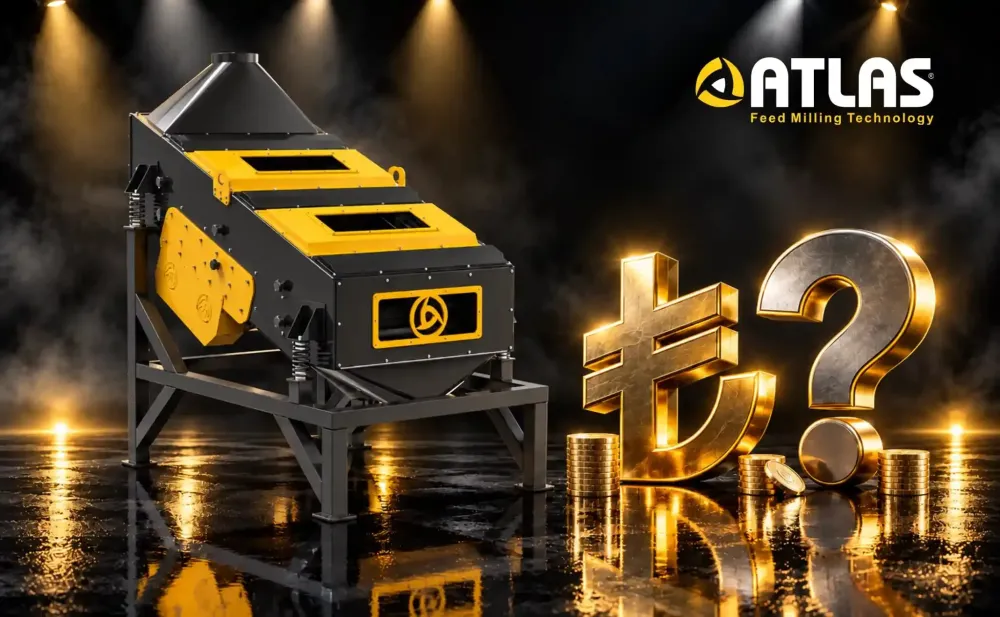
How Much Does a Vibrating Screen Cost?
Vibrating screen prices are not fixed enough to be expressed as a single figure. The price varies depending on screening capacity, screen surface dimensions, number of decks, the material used and the needs of the plant. That is why the requirement must be clearly defined before requesting an accurate quote. In this article, we cover the main factors that determine vibrating screen prices and the points to consider when making a choice.
What is a vibrating screen?
A vibrating screen is a screening machine that separates materials by size using vibration. As the material moves across the screen surface, smaller particles pass through the openings, while larger particles remain on the screen and are discharged from a separate outlet. In feed mills, it is used in stages such as raw material cleaning and post-pellet screening.
Which processes is a vibrating screen used in?
In feed production, a vibrating screen is used in the following processes:
- Pre-cleaning of raw materials
- Classification of ground products
- Separation of dust and fines after pelleting
- Separation of products of different sizes
What do vibrating screen prices depend on?
Vibrating screen prices depend mostly on capacity and screen area. A machine that screens more product per hour requires a larger screen surface and a more powerful drive system. In addition, the thickness of the sheet metal, whether stainless steel is preferred and the number of decks also directly affect the price.
What are the main factors that determine the price?
The following points are evaluated when preparing a quote:
- Hourly screening capacity
- Screen surface size and number of decks
- Screen mesh opening sizes
- Body material: carbon steel or stainless steel
- Motor power and vibration system
- Dust aspiration connection and enclosed body requirement
How do vibrating screen types affect the price?
Vibrating screen types have different designs depending on their intended use. A single-deck screen separates only two different sizes, while a multi-deck screen can perform several classifications at the same time. More decks mean more material and labor, so the price changes accordingly.
What types of vibrating screens are available?
The following types are commonly used in feed plants:
- Single-deck vibrating screen
- Multi-deck vibrating screen
- Raw material cleaning screen
- Pellet screen
- Enclosed dust-free screen
What is the difference between a vibrating screen, a vibro sieve and a trommel sieve?
A vibrating screen works with a reciprocating or circular oscillating motion. A vibro sieve uses higher-frequency vibration and is preferred especially for fine and precise screening. A trommel sieve, on the other hand, screens material inside a rotating cylindrical drum and is generally used for raw material pre-cleaning. Since each machine has a different operating principle, their prices also differ.
Which screen is best suited for which job?
A general comparison can be made as follows:
- Vibrating screen: Post-pellet screening and product classification
- Vibro sieve: Precise screening of fine powder products
- Trommel sieve: Pre-cleaning at raw material intake
What should you consider when buying a vibrating screen?
Choosing a vibrating screen based on price alone can lead to efficiency losses and additional costs later on. A screen with insufficient capacity slows down the line, while the wrong mesh size impairs product quality. For this reason, machine selection should be evaluated together with the overall production flow of the plant.
What questions should be asked to choose the right vibrating screen?
Before purchasing, answers to the following questions should be sought:
- How much product will be screened per hour?
- Which materials and which sizes will be separated?
- At which point in the line will the screen operate?
- Is a dust aspiration system required?
- Are spare screen meshes and service support provided?
Why is quality important in vibrating screen manufacturing?
Because a vibrating screen operates under constant vibration, the body, connection points and springs carry significant loads. In a screen made from low-quality materials, problems such as cracks, loosening and screen mesh tearing occur more frequently. Even if the initial investment cost is low, frequent breakdowns and downtime increase the total cost.
What features does a quality vibrating screen have?
A long-lasting screen should have the following features:
- Vibration-resistant body structure
- Easily replaceable screen meshes
- Balanced and quiet drive system
- Dust-tight enclosed body
- Easy cleaning and maintenance
How do you get a quote for vibrating screen prices?
To get an accurate price quote, the manufacturer should be given information about capacity, the material to be screened, the required separation sizes and the point of use in the plant. A quote prepared with this information ensures that the right machine is selected and unnecessary costs are avoided. You can contact our team for information about Atlas Yem vibrating screen models and other screening systems.
What information should be shared when requesting a quote?
The following information is sufficient for a fast and accurate quote:
- Hourly screening capacity
- Type of product to be screened
- Required separation sizes
- Number of screen decks
- Dimensions of the installation area