How Are Screw Conveyor Flights Manufactured? - Atlas Yem
News
How Are Screw Conveyor Flights Manufactured?
How Are Screw Conveyor Flights Manufactured?
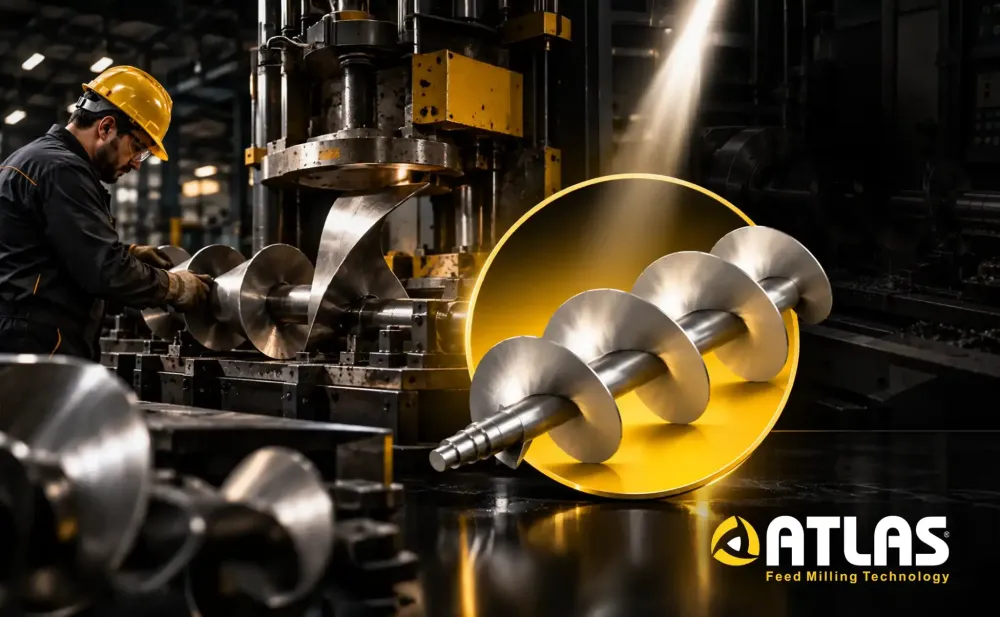
The screw flight is the core part that allows screw and tube screw conveyors to move material. Manufacturing the flight to the right dimensions and with the right method directly affects the conveyor’s capacity, energy consumption and service life. In this article, we explain the stages of screw flight manufacturing, the methods used and how screw flight dimensions are calculated.
What is a screw flight?
A screw flight is a steel part that turns in a spiral around a shaft and pushes material from one point to another. It is used in feed mills, flour and grain plants, silo systems and many industrial conveying lines. The performance of conveyors such as tube screw conveyors and U-trough screw conveyors depends largely on the quality of the flight.
What parts does a screw flight consist of?
- Outer diameter: The outermost edge of the flight
- Inner diameter: The part of the flight that sits on the shaft
- Pitch: The distance between two crests
- Sheet thickness: The wall thickness of the flight
- Direction of rotation: Right-hand or left-hand helix
How are screw flight dimensions determined?
Screw flight dimensions must be finalised before manufacturing starts. The outer diameter is determined according to the inner diameter of the conveyor housing, leaving a small clearance between the housing and the flight. The inner diameter must be equal to the shaft diameter. The pitch is usually chosen close to the outer diameter, but a shorter pitch may be preferred for inclined conveying and dosing screws.
How are screw flight dimensions calculated?
In segmented manufacturing, the flight is cut from a flat sheet ring and formed by stretching. The dimensions of this ring are calculated in the following steps:
- Outer developed length: L = √((π × D)² + P²)
- Inner developed length: l = √((π × d)² + P²)
- Ring width: b = (D − d) / 2
- Inner radius of the sheet ring: r = b × l / (L − l)
- Outer radius of the sheet ring: R = r + b
Here D is the outer diameter, d the inner diameter and P the pitch. The calculated ring is cut open at one point and stretched by the pitch to give it its helical form.
Which methods are used in screw flight manufacturing?
Screw flights are manufactured with two main methods: segmented manufacturing and continuous cold rolling. The method chosen depends on the flight dimensions, sheet thickness and production quantity.
What is the difference between segmented and rolled screw flights?
- Segmented manufacturing: Each turn is cut from a separate sheet ring, formed and welded end to end. It is preferred for thick sheets and large diameters.
- Continuous rolling: A steel strip is cold-rolled between rollers into a continuous helical form. It is advantageous for serial production and thin sheets.
- Segmented manufacturing offers high dimensional flexibility.
- Rolled flights have fewer weld seams and a smoother surface.
What stages does screw flight manufacturing consist of?
Segmented screw flight manufacturing is completed in several stages, from defining the dimensions to mounting on the shaft. Paying attention to dimensional tolerances at every stage ensures the flight rotates smoothly inside the conveyor.
What are the manufacturing stages?
- Screw flight dimensions and ring dimensions are calculated.
- The sheet is cut into a ring by laser or plasma.
- The ring is cut open at one point.
- It is stretched by the pitch and formed with a press or special fixture.
- The flights are joined end to end and welded.
- They are fitted onto the shaft, fixed by welding and balance-checked.
Which materials are used in screw flight manufacturing?
Material selection depends on the abrasiveness of the product to be conveyed and the working environment. Carbon steel is usually sufficient for conveying feed and grain, while wear-resistant steels are preferred for abrasive materials. Stainless steel is used in applications that require food hygiene.
Which materials are preferred for screw flights?
- Carbon steel: Standard feed and grain conveying
- Wear-resistant steel: Abrasive raw materials
- Stainless steel: Food and hygiene-critical lines
- Hardfaced surface: High-wear zones
What should be considered when manufacturing flights for a tube screw conveyor?
Because a tube screw conveyor has an enclosed pipe housing, the clearance between the flight and the housing must be set more precisely. If the clearance is too large, material slips back and capacity drops. If it is too small, the flight rubs against the housing and wear increases. For this reason, special attention is paid to the outer diameter tolerance of tube screw flights. In Atlas Yem tube screw systems, flight and housing dimensions are designed together.
What is checked on a tube screw flight?
- Clearance between the outer diameter and the tube’s inner diameter
- Pitch remaining constant along the length
- Quality of the weld seams
- Straightness and balance of the shaft
How can you tell a high-quality screw flight?
A high-quality screw flight matches its dimensions exactly, rotates smoothly and works for a long time without wearing. There should be no waviness, irregular pitch or weak weld seams on the flight surface. For your conveyor spare parts, explore Atlas Yem screw flight products in different dimensions.
What should you look for when buying a screw flight?
- Screw flight dimensions that fit the conveyor exactly
- Sheet thickness suited to the material
- Even pitch along the entire length
- Weld and surface quality
- The manufacturer’s ability to produce custom sizes