Trommel Sieve vs Vibro Sieve: Key Differences - Atlas Yem
News
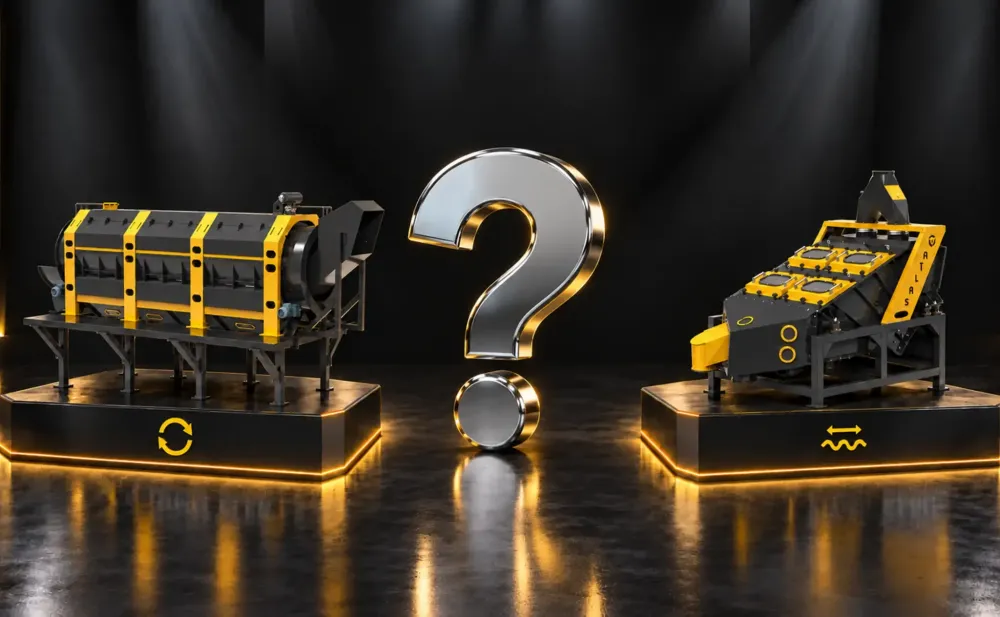
What Is the Difference Between a Trommel Sieve and a Vibro Sieve?
What Is the Difference Between a Trommel Sieve and a Vibro Sieve?
In feed mills and recycling plants, screening is a stage that directly affects product quality. Two of the most commonly used machines at this stage are the trommel sieve and the vibro sieve. Both machines separate material by size, but their working principles and areas of use differ. In this article, we explain the differences between a trommel sieve and a vibro sieve and when each one should be preferred.
What is a trommel sieve?
A trommel sieve is a screening machine consisting of a cylindrical drum that rotates around its own axis. It is also known as a trommel screen or rotary drum screen. The holes on the drum surface separate the material by size. Fine particles pass through the holes, while coarse particles are discharged at the end of the drum.
What is a trommel sieve used for?
A trommel sieve is generally preferred for the pre-separation of coarse and mixed materials:
- Pre-cleaning at raw material intake in feed mills
- Removing straw, string and large foreign matter from grain
- Classifying waste by size in recycling plants
- Screening compost and organic materials
What is a vibro sieve?
A vibro sieve is a screening machine that works with the vibration generated by vibration motors. Thanks to vibration, the product spreads evenly over the screen surface and is separated by size. The vibro sieve stands out especially in tasks that require precise screening.
What is a vibro sieve used for?
A vibro sieve is generally used at the following stages:
- Separating dust and fines at the pellet cooler outlet
- Final quality control before packaging
- Particle size control after grinding
- Classifying granular products by size
What are the main differences between a trommel sieve and a vibro sieve?
The biggest difference between the two machines is their working motion. A trommel sieve screens inside a rotating drum, while a vibro sieve works with vibration on a flat screen surface. For this reason, a trommel sieve is suitable for coarse and irregular materials, while a vibro sieve suits products that require finer and more precise screening.
In which criteria do they differ?
Trommel sieves and vibro sieves differ in the following respects:
- Working motion: Rotating drum or vibration
- Material type: Coarse and mixed material or fine and granular product
- Screening precision: Pre-separation or precise classification
- Position in the line: Raw material intake or product outlet
- Clogging tendency: The trommel sieve has the advantage with moist and fibrous material
Should a feed mill use a trommel sieve or a vibro sieve?
In feed mills, these two machines are usually not alternatives but complements to each other. The trommel sieve cleans grain of foreign matter at the raw material intake point, while the vibro sieve removes dust from pelleted feed at the end of production. This both protects the machines and improves product quality.
How are screening systems positioned in the line?
In a standard feed mill, screening points are planned as follows:
- Pre-cleaning with a trommel sieve at raw material intake
- Particle control after grinding
- Dust separation with a vibro sieve at the pellet cooler outlet
- Final control screening before packaging
What should be considered when choosing a trommel sieve?
When choosing a trommel sieve, the type and quantity of the material to be screened should be determined first. Drum diameter and length determine capacity, while screen hole size determines the separation size. For moist or sticky materials, models with brush or air cleaning systems should be preferred. Atlas Yem trommel sieve systems can be configured for different material and capacity needs.
What information is needed to choose a trommel sieve?
The following information should be clarified to choose the right trommel sieve:
- Hourly capacity
- Material type and moisture content
- Desired separation size
- Dimensions of the installation area
What should be considered when choosing a vibro sieve?
When choosing a vibro sieve, the granule size of the product, hourly capacity and the number of sizes to be separated are decisive. Multi-deck vibro sieve models can perform more than one classification at the same time. Quick-change screen frames shorten maintenance time. Atlas Yem vibro sieve models are offered in different capacities suitable for pelleted and granular feed production.
What information is needed to choose a vibro sieve?
The following information is evaluated to choose the right vibro sieve:
- Product type and granule size
- Hourly screening capacity
- Number of screen decks
- Dust extraction requirement
- Position in the line and connection points