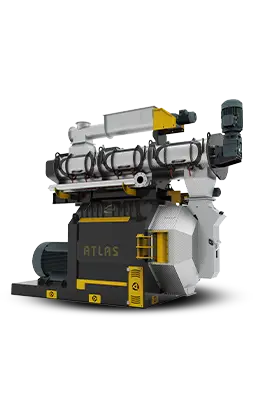
How Does a Pellet Press Machine Work? Stages and Parts
News
How Does a Pellet Press Machine Work?
A pellet press machine compresses mash compound feed with the help of steam, heat and pressure and turns it into cylindrical pellets. Located at the heart of the pelleting line in feed mills, this equipment makes feed easier for animals to consume, reduces dust and makes the feed easier to transport. In this article, we answer the basic questions about the pellet press in plain language: its working stages, main parts and how to choose the right pellet feed machine.
What does a pellet press machine do?
Mash feed can segregate during transport and storage; heavy and light ingredients separate from each other. A pellet press machine binds this mixture into a single form, so every bite delivers the same nutritional value. It also reduces feed volume, dust and feed losses. That is why the pellet feed machine is one of the indispensable pieces of equipment in plants producing feed for beef cattle, dairy cattle and poultry. Among the agricultural machines used in feed production, the pellet press is one of those with the most direct impact on livestock productivity.
What are the advantages of pelleted feed?
Compared to mash feed, pelleted feed offers the following advantages:
- Animals cannot feed selectively and consume a balanced ration.
- Dust and waste are reduced.
- Storage and transport volume decreases.
- Heat treatment supports feed digestibility.
- Feed flowability improves, making it easy to use in automatic feeding systems.
What is the working principle of a pellet press?
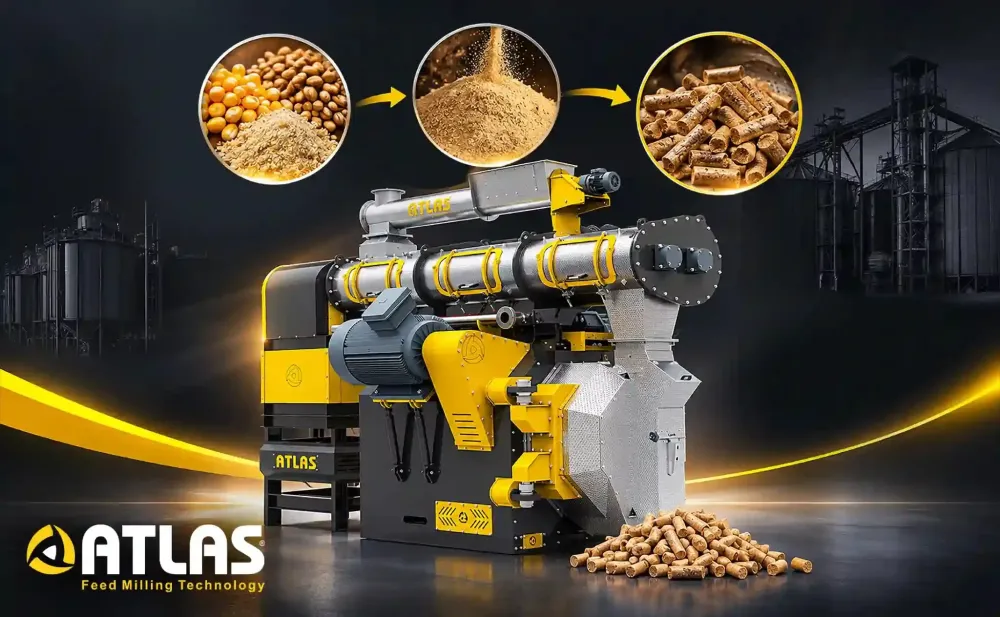
The working principle of a pellet press is based on compressing conditioned feed between a rotating die and the rollers turning inside it. Under the pressure of the rollers, the feed is forced through the holes of the die and takes on a cylindrical shape as it exits. The feed coming out of the holes is cut to the desired length by knives on the outer surface of the die. In short, a pellet press uses pressure and friction to turn mash feed into a dense, durable structure.
What stages does a pellet press machine work through?
A pellet press machine generally works in the following order:
- Compound feed is taken from the bin into a variable-speed feeder screw.
- The feed is heated and moistened with steam in the conditioner.
- The conditioned feed is delivered to the pelleting chamber by a force feeder.
- The rollers press the feed through the holes of the pellet press die.
- The pellets leaving the die are cut to the desired length by knives.
- Hot pellets are sent to the cooler, then to screening and storage.
What are the main parts of a pellet press machine?
Although a pellet press consists of many parts, the components that affect pellet quality the most are the die, the rollers and the cutting knives. The pellet press die determines the diameter and density of the pellet. The pellet press roller is the part that presses the feed into the die holes. The knives determine pellet length and how clean the cut surface is. How well these parts work together directly affects pelleting efficiency.
Which part performs which function?
The functions of the main parts can be summarized as follows:
- Pellet press die: Determines pellet density through its hole diameter and compression ratio.
- Pellet press roller: Presses the feed onto the die surface and pushes it into the holes.
- Cutting knife: Cuts the pellet to the desired length with a clean cross-section.
- Conditioner: Applies steam to the feed and prepares it for compression.
- Drive system: The motor and power transmission elements that rotate the die.
How does the conditioner affect pellet quality?
The conditioner is the mixing section that applies steam to the feed before the pellet press machine. Steam gelatinizes part of the starch in the feed and softens the proteins. As a result, feed particles bind together better and form hard, durable pellets. Without adequate conditioning, the pellet press consumes more energy and the share of broken pellets increases.
What matters for good conditioning?
On the conditioner side, the following points are important:
- Using dry, saturated steam
- Keeping the feed in the conditioner long enough
- Continuously monitoring temperature and moisture values
- Adjusting the amount of steam according to the ration
What should you consider when choosing a pellet feed machine?
The right pellet feed machine should be selected according to plant capacity, the type of feed produced and the raw materials. Small-diameter pellets are produced for poultry feed and larger-diameter pellets for cattle feed, which changes the choice of die. Main motor power, die diameter and the number of pellet press rollers are the main factors that determine the machine’s hourly capacity. Since the pellet press is one of the agricultural machines with the highest motor power in a feed mill, correct sizing also determines energy costs.
Which criteria should be compared?
When evaluating a pellet feed machine, look at the following criteria:
- Hourly production capacity and main motor power
- Die diameter and different hole diameter options
- Conditioner type and compatibility with the steam system
- Spare parts availability and service support
- Automation and overload protection systems
How can pellet press efficiency be increased?
Pelleting efficiency depends on the grinding fineness of the raw material, conditioning quality and the condition of the parts. A worn pellet press die or a pellet press roller with a flattened surface results in less output for the same energy. A regularly maintained pellet feed machine both lowers energy consumption and preserves pellet durability (PDI).
What should be checked during daily maintenance?
A regular checklist should include the following items:
- Checking whether the die holes are clogged
- Adjusting the gap between the roller and the die
- Sharpness and position of the knives
- Timely bearing lubrication
- Monitoring motor current and vibration values
Atlas Yem pellet press solutions
Atlas Yem offers pellet press machines and complementary pelleting equipment for feed mills of different capacities. Spare parts such as dies, rollers and knives can also be supplied for the same line. Contact our team to find the right pellet press for your plant.